26/Nov/2025
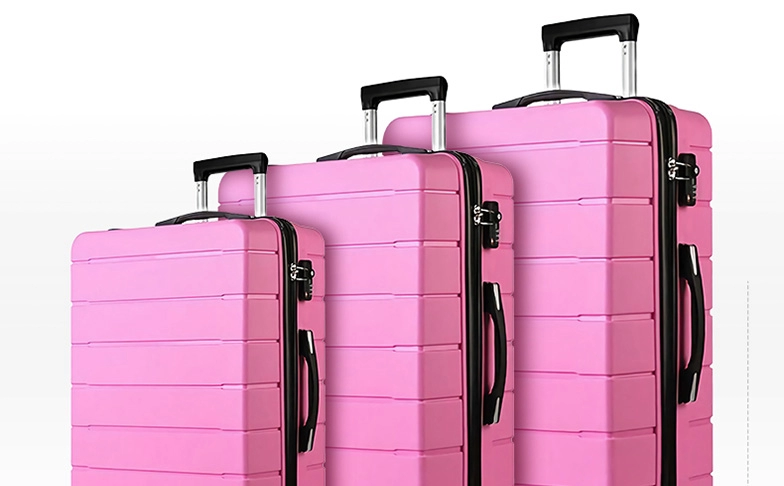
2kg Ultra-Light PC Luggage Arrives
Discover how our craftsmanship perfects every detail to make your travel effortless
Learn More


Recently, comprehensive performance benchmark tests have been completed between Armopack multi-layer composite panels and mainstream Covestro PC sheets. Armopack achieves revolutionary upgrades across six critical dimensions, balancing lightweight design, superior impact resistance, scratch resistance, wide weather tolerance, simplified production workflow and BPA-free safety. It delivers a next-generation high-performance material solution for luggage shells, outdoor enclosures, transport containers and more industrial applications.
Density of Armopack: 0.95–0.97 g/cm³, vs 1.22 g/cm³ for PC sheets. Armopack is 19%–21% lighter at identical thickness.
Outstanding performance in thin-gauge thermoforming: Armopack raw sheets can be manufactured to 1.9–2.3 mm, remaining over 1.2 mm after thermoforming. A 20-inch shell weighs only 750–850 g.
To reach the same lightweight weight target, PC sheets must be reduced to 1.7 mm, thinning to merely 0.8–0.9 mm post-forming. This causes frequent cracking during stitching and riveting, raising production waste rates. Armopack delivers a substantial, solid texture while cutting weight, balancing tactile quality and production yield.
2. Multi-Layer Composite Structure Delivers 5x Higher Impact Resistance
PC sheets require 2.5 mm thickness, passing only 50 cycles in drum drop testing before damage.
Armopack allows a thicker 2.9 mm substrate, sustaining over 250 drum test cycles. Its superior impact durability perfectly fits long-distance shipping and outdoor heavy-scratch scenarios.
Pencil hardness: Armopack H–2H, Covestro PC BH–H.
PC sheets are prone to irreversible scratches during production, storage and transportation, leading to high rework and scrap costs. Armopack’s upgraded surface hardness minimizes surface damage throughout the supply chain, lowering overall manufacturing expenses long-term.
Low-temperature performance: Armopack retains full physical integrity at -40°C; PC sheets rapidly lose toughness and impact resistance below -20°C, prone to cracking in cold climates.
High-temperature stability: Both materials withstand heat above 80°C without deformation, meeting standard container shipping temperature requirements.
Thermoforming efficiency: Both materials cure instantly after forming, while Armopack’s superior elasticity enables easier demolding and faster production cycles.
Covestro PC absorbs water (water absorption rate: 0.12%). Unformed PC sheets must be thermoformed within a short timeframe and stored in temperature-controlled ovens, incurring extra equipment, labor and inflexible production planning.
Armopack boasts ultra-low water absorption (<0.01%) with native water-repellent properties. No special drying ovens or climate-controlled storage are required, allowing flexible production scheduling, faster workshop turnover and reduced material waste.
Covestro PC is formulated with Bisphenol A (BPA). Under high-temperature conditions (summer heat, car trunks, tropical transit), BPA residues release persistent volatile substances, posing health risks especially to infants, kids and pregnant women.
Armopack panels are inherently BPA-free, complying with strict global environmental and safety regulations. They are ideal for children’s luggage, maternal storage cases, food-contact enclosures and other health-sensitive products.
Comparative Property Table
| Performance Index | Armopack Composite Panels | Covestro PC Sheets |
|---|---|---|
| Material Density | 0.95–0.97 g/cm³ | 1.22 g/cm³ |
| Surface Pencil Hardness | H–2H | BH–H |
| Drum Impact Test | Over 250 cycles | 50 cycles |
| Operating Temperature Range | -40°C ~ 80°C | -20°C ~ 80°C |
| Water Absorption Rate | <0.01% | 0.12% |
| Safety Standard | 100% BPA-Free | Contains BPA, volatile under heat |
| Anti-Yellowing Performance | Multi-layer UV protection, no discoloration | Prone to yellowing over time |