
18/Dec/2025
TRAVEL WITH EASE FOR CHILDREN'S FAMILY
Learn More


When you source soft-sided luggage, the most common questions from buyers are also the most misunderstood: What is 210D? Is peach skin durable? What exactly is "Chunqiu Ding"? As a manufacturer that works with these fabrics every day, Greatchip wants to take the mystery out of the three materials we use most often.
The letter D stands for Denier — the unit that measures yarn thickness. Technically, one denier equals the weight in grams of 9,000 meters of that yarn. So 210D means a single strand of this yarn weighs 210 grams per 9,000 meters; 600D means 600 grams over the same length.
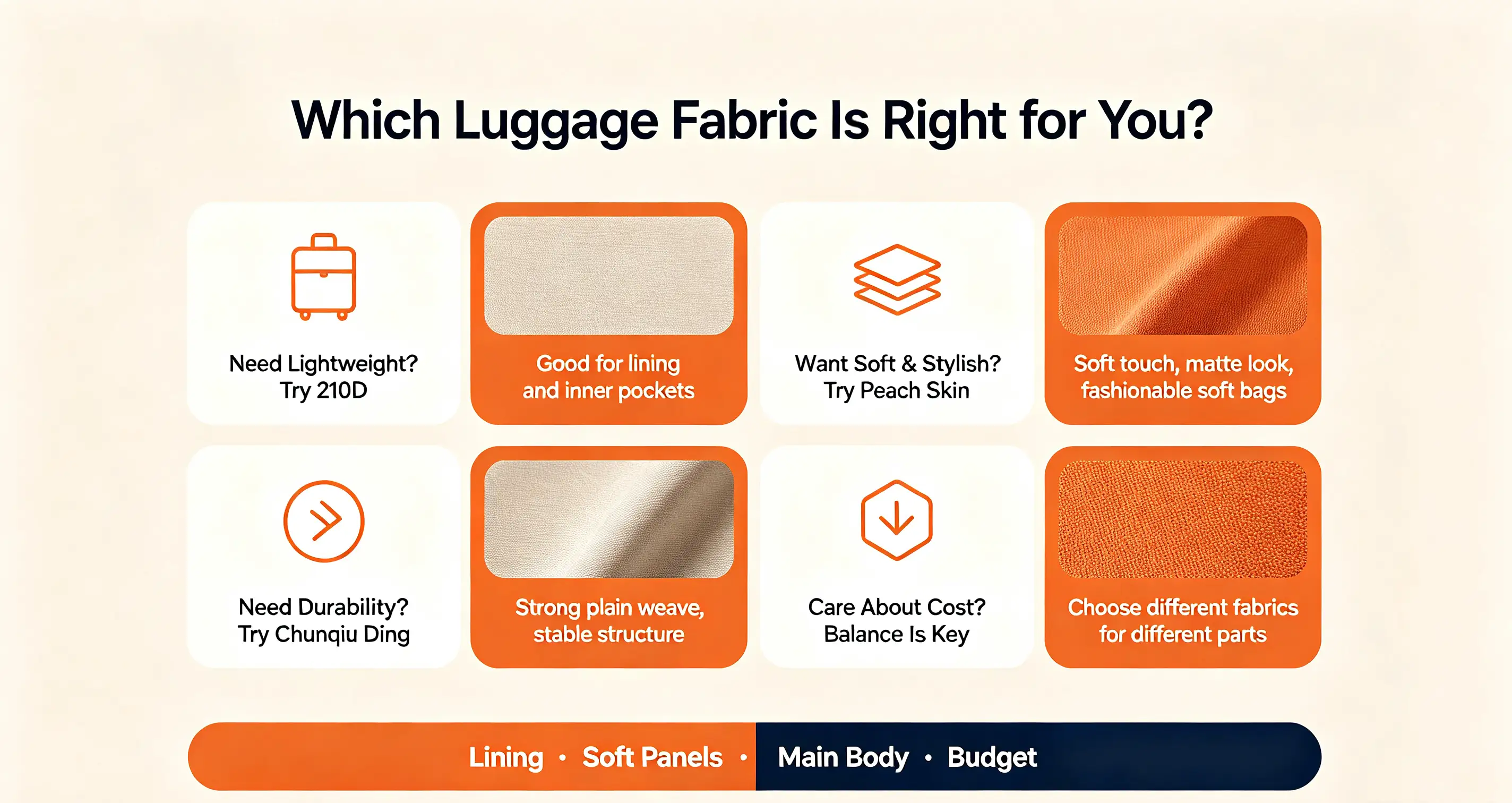
210D is almost always an interior fabric, not an exterior one. In soft-sided luggage, it is the textile you see when you open the case — lining the main compartment, zipper pockets and divider flaps. It is typically made of 100% polyester (sometimes nylon in premium lines).
Because it hits the sweet spot: light enough to keep the overall weight down, tightly woven so it resists snagging on zippers and buckles, wrinkle- and shrink-resistant, and cost-effective enough to be the default choice across entry- and mid-tier luggage.
210D is not designed to take abrasion from tarmac or conveyor belts. If you see a soft-shell suitcase advertised as "210D," double-check whether that refers only to the lining — the outer fabric is usually a much heavier denier such as 420D, 600D or 1680D.
Peach skin (or "peachskin") is a 100% polyester microfiber that goes through a sanding/brushing finish, leaving an extremely short, almost invisible nap on the surface. Run your hand across it and you feel something between suede and silk — soft, dry, matte.
Because of its tactile luxury, peach skin is a favorite for fashion-forward soft luggage, beauty cases, weekenders and women's travel bags. It takes dye beautifully, holds rich colors, and gives a matte, upscale appearance without the cost of real leather.
The same fine nap that feels wonderful can also show scuffs and abrasion more visibly than a tight plain weave. It is best suited to consumers who value hand-feel and appearance over rough-and-tumble travel. At Greatchip, we typically pair peach-skin outer fabrics with PU or PVC backing to improve water resistance and tear strength.
"Chunqiu Ding" (春秋丁) is a Chinese-market fabric name that does not have a widely used English equivalent. Technically it describes a 100% polyester plain-weave taffeta, most commonly woven from 150D × 150D DTY yarn at around 95–104 g/m² on water-jet looms. Exporters often list it as "lightweight polyester taffeta" or "chunqiu pongee."
It feels lighter and crisper than peach skin, has a subtle satin-like sheen, and is commonly treated with a light PVC or PU coating for water resistance. The weave is relatively open but surprisingly tear-resistant, with good breathability. It is widely used in backpacks, casual day bags, luggage linings, cosmetic cases and promotional bags — especially in value-oriented product lines.
| Fabric | Typical Use in Luggage | Hand Feel | Weight | Best For |
|---|---|---|---|---|
| 210D (polyester/nylon) | Interior lining, pocket dividers | Smooth, flat, light | Very light | Lining across all tiers |
| Peach skin (polyester microfiber, brushed) | Soft exterior, fashion bags, beauty cases | Soft velvety nap, matte | Light–medium | Premium fashion soft luggage |
| Chunqiu Ding (polyester taffeta, 150D) | Exterior or lining, backpacks, casual bags | Smooth, crisp, subtle sheen | Light (~95–104 gsm) | Value-oriented soft luggage, promotional lines |
There is no single "best" fabric — only the best match for your target consumer and price point:
• Budget / entry-level luggage: Chunqiu Ding or 210D outer with 210D lining keeps weight and cost down.
• Mid-tier everyday soft luggage: 600D / 900D plain weave outer with 210D lining — the most common, most forgiving combination.
• Premium fashion line: Peach skin outer with reinforced backing, paired with a high-quality 210D or 230D lining.